
'The King Love Him Much'
Edward IV's and the Duke of Somerset's short - lived 'bromance'

By Christmas Eve the castles of Alnwick, Dunstanborough and Bamburgh had been holding out against the determined Yorkist forces for a number of months. The cold English winter had long since crept in and it is possible that the Lancastrian forces defending these three outposts of resistance feared that supplies would not last into the new year. This desperation added to the pressure of being under constant bombardment from catapults, trebuchets and cannons which could imaginably drive the sanest person mad. And so on 24 December 1462, the recently crowned twenty year old king Edward IV was greeted with an early Christmas present. Bamburgh and then Dunstanborough, a matter of days later surrendered
After initially waving the white flag of surrender to the commander of the sieges, the earl of Warwick, the two men were sent to the great northern city of Durham where Edward had been taken seriously ill with measles. Both of these men represented the last dregs of the Lancastrian cause in England, one was Sir Ralph Percy, son to the deceased earl of Northumberland whilst the other was Henry Beaufort, 3rd duke of Somerset, his father had been brutally hacked down in the streets of St Albans five years prior on the order’s of the current king’s father, Richard, 3rd duke of York. Somerset had extracted his own revenge in late 1460 when he led the force that defeated and ultimately murdered the ambitious duke of York at the battle of Wakefield.
When Somerset met the new king there should have been a heavy animosity between the two, the Beaufort’s and the Yorkists had an embittered rivalry which stretched back to at least a decade and both of their families had been respectively implicit in the murder of each other’s father’s, however it proved to be the opposite and the two men quickly struck something of a repour. Afterall they were cousins by many degrees but the closest was through Somerset's father, Edmund Beaufort, 2nd duke of Somerset and Edward IV’s mother, Cecily Neville, duchess of York who were first cousins (Cecily was the daughter of Joan Beaufort, countess of Westmorland and thus the niece of John Beaufort, 1st earl of Somerset and Edmund’s father) making the two second cousins.
The reason behind one of the house of Lancaster’s stoutest supporters submittal to the new regime is still somewhat of a mystery, it has been theorised that he had had a disagreement with the nominal figure head of the Lancastrians, Margaret of Anjou, queen of England and wife to Henry VI, or may have simply been that Somerset realising that fortune’s wheel had once again turned, toppling and crushing him under it’s weight, simply accepted the olive branch offered to him by the new king.
As the king left the last stages of the sieges in the north of the country to his right hand man, the earl of Warwick, he along with Somerset who accompanied him retreated to London where the duke found significant favour, the medieval chronicler Gregory who proves to be one of the best authorities on this event records that the ‘king made full much of him’. On 10 March 1463 the duke was granted a general pardon and the month after he was restored to his ‘name, state, stile, honour and dignity’. On top of rising to prominence at the new Yorkist court, the duke of Somerset also began to receive gifts of money from his king before an annuity was settled upon him and his mother, the widowed dowager duchess of Somerset, the former’s amounted to £222 whilst the latter’s tallied up to £222 4s, and 6d which was granted to them both on 30 March 1463.
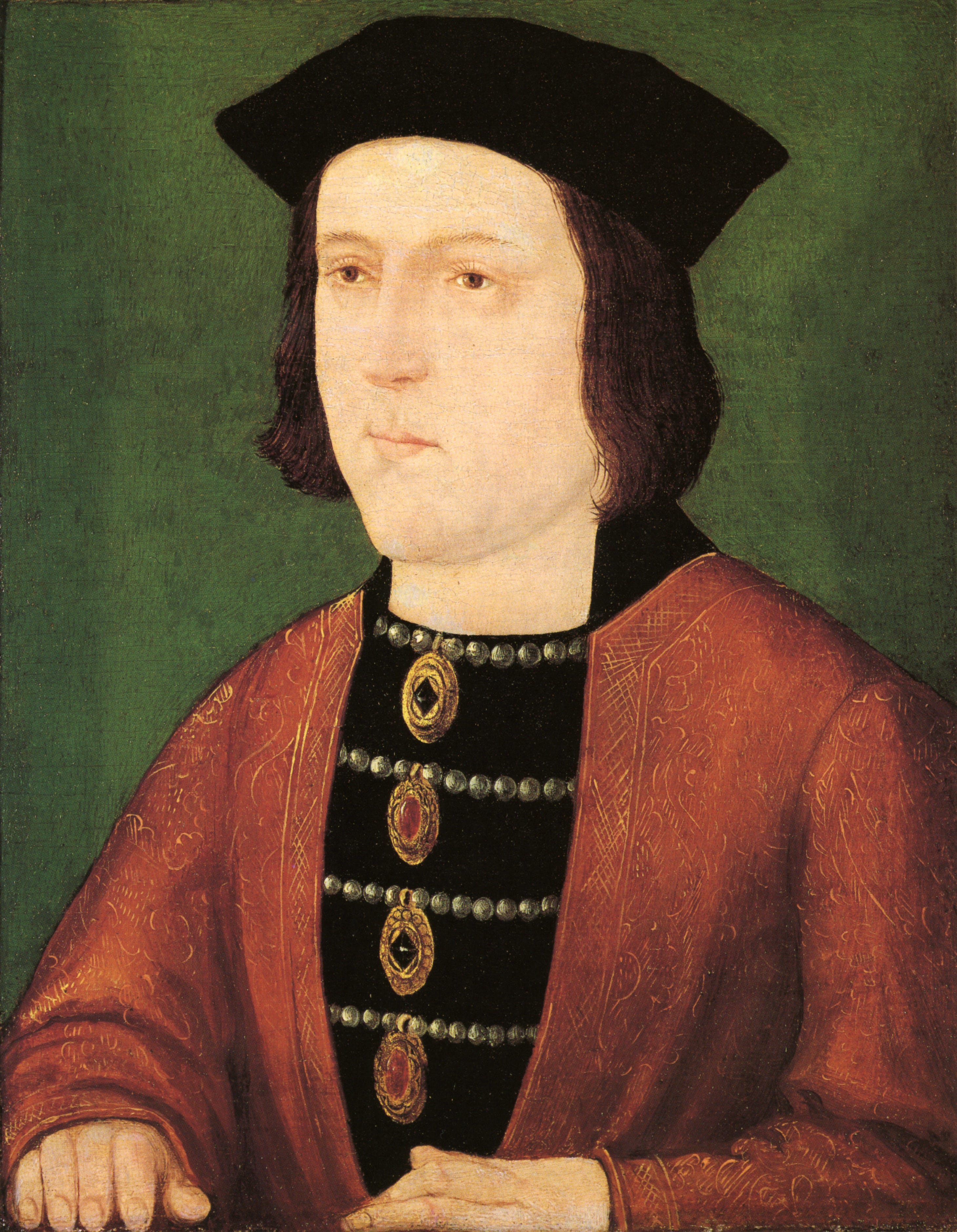
The First Yorkist King, Edward IV
Whilst being showered in gifts Somerset also seems to have quickly entered the kings confidence with the two men often hunting together. Not only is the duke’s favour highlighted through the fact that he went hunting with Edward but also by the amount of his own personal retainers that he was allowed to bring with him on the venture. Once again Gregory notes that the king had six horses at the most ‘and yet three were of the duke of Somerset’s men’.
If the reversal of Somerset’s fortunes, the gifting of large sums of money and allowing his company for one of the greatest noble sports wasn’t enough, Edward also ordered that jousts be held at the city of Westminster in the duke of Somerset’s honour which he seems to have participated in.
As can be seen in the months after Somerset’s initial submission Edward seemed to go all out in order to secure the duke’s loyalty to the new regime. This was a policy that the Yorkist king followed in the early years of his first reign whilst knowing that he had to rewards the men who had been loyal to him namely his maternal family, the Neville’s he also knew that he had to try and earn the support of Lancastrian sympathisers and supporters if he truly wanted to reunite the country under his rule.
However, Edward’s favouring of the duke of Somerset has been viewed by some historians (namely Ricardian Dr John Ashdown - Hill) as being excessive and that the two may have in fact shared more than a friendship and instead their relationship was an intimate one. This point is usually argued on an observation made by Gregory that the king and the duke shared a bed on more than one occasion.
To quote Gregory again:
‘And the king made full much of him, insomuch that he lodged with the king in his own bed many nights'.
Whilst we now assume that two people sharing a bed means that they have a romantic relationship, this for king Edward and his distant cousin, the duke of Somerset does not seem to be the case. In the medieval period communal sleeping as a whole was not unusual with men often sleeping side by side when travelling but it had been custom between a king and a friend throughout the medieval period, an example being in 1189 when the famous English king, Richard I, better known as the ‘Lionheart’ shared a bed for the night with a man that would later be his sworn enemy, Philip II, king of France, nicknamed ‘Augustus’. The sharing of a bed between a king and a noble (or a fellow king) was not about intimacy but a show of high favour or friendship as was the case with Richard and Philip in the late twelfth century as well as the numerous instances between Edward and Henry in the fifteenth century. Though it was also later rumoured that Richard I was possibly bisexual due to this event it seems highly unlikely that Edward was when considering his notorious appetite for womanly company, fathering ten children with his controversial wife, Elizabeth Woodville and a further five illegitimate children with various mistresses.
Whilst Edward seemed to be enamoured by his new friend, the commons of England were evidently less so. When the king visited the town of Northampton in 1464, along with the duke of Somerset, the commons of the town ‘arose’ against Somerset upon seeing how close he was to Edward and that he made up a part of his armed guard. Gregory, our best source for the relationship between king and duke even notes that the inhabitants of Northampton would have slain Somerset if it was not for Edward’s ‘fair speech’ and offering of free wine. The king’s quick thinking ultimately saved the life of the man who was arguably becoming his favourite.
Although tensions had calmed, there seems to have been ill feeling towards the duke of Somerset as Edward sent him to ‘ a castle of his own’ likely for safekeeping. However, it is here that the relations between the two men began to deteriorate. Much like Somerset’s initial motives to submit to the Yorkist regime, the key reason behind his decision to return to the Lancastrian dynasty is unknown but is much easier to understand. The duke was a Beaufort, he was a close relative of the previous king being a direct descendant of John of Gaunt, duke of Lancaster and more importantly his family had fought against Edward’s for nearly a decade, his father dying as a result of this feud at St Albans in May 1455.
Furthermore, Somerset was a known stalwart of the Lancastrian dynasty, a man who had led the attack against the duke of York at the Battle of Wakefield and against the earl of Warwick at the Second Battle of St Albans. He was never going to be accepted by the Yorkists and their supporters with open arms as was made abundantly clear at Northampton where he was attacked and very nearly killed.
The duke of Somerset appears to have been sent to Holt Castle, a fortress on the Welsh - English border dating from roughly the thirteenth - century seemingly for his own safety after the close - call at Northampton. It was during this moment of isolation that Henry made the decision to return to his old allegiances with the Lancastrians and fled north towards the base of the former English queen, Margaret of Anjou. With the return of her main lieutenant Margaret and Somerset began to make plans to retrieve the throne for the country’s true king, Henry VI.
A Lancastrian army, headed Somerset and including Thomas Roos, 9th baron Roos of Hemsley, Robert Hungerford, 3rd baron Hungerford as well as Sir Ralph Percy, son to Henry, 2nd earl of Northumberland, (killed at the First Battle of St Albans) and brother to the recently slain 3rd earl of Northumberland (killed at or soon after the battle of Towton), marched through Northumberland gaining support as they went.
As Somerset and his fellow remaining Lancastrians marched through the north of the kingdom, Edward IV had sent his cousin John Neville, lord Montagu (later earl of Northumberland) towards the gathering army. Montagu and his force were to act as an armed escort for a travelling Scottish embassy who wished to open talks with the recently crowned Edward at York. As Montagu made his way through the north of the country he was nearly ambushed by Somerset’s army who wished to remove one of the new king’s greatest supporters. The Lancastrians were unsuccessful with Neville being able to escape and gather more men to repel his opposition. This was not to be the last time that Somerset and lord Montagu would meet.
After gathering further troops Montagu’s army numbered roughly 5,000 men when he was once again confronted by the Lancastrian forces under Somerset and lords Roos, Hungerford as well as Sir Richard Percy on 25 April at Hedgley Moor. After a flurry of arrows was loosed on both sides, before Montagu marched towards his opposition which promptly began to falter and soon break away, leaving only Percy to really put up a fight against the Yorkist nemesis. Whilst the majority of the Lancastrian forces fled Sir Richard and his household retainers stood their ground before being brutally slain in the hand to hand combat.
This was hardly the result that the duke of Somerset would have wanted, only recently to the side of king Henry VI in the hope of retrieving the English crown for him. It was an ominous start. One that would only get worse.
With a significant portion of the Lancastrian forces dispersed, Montagu and his men who hardly suffered any losses at the recent skirmish made their way towards the Scottish delegates that awaited them before escorting them to York in hope of settling a long term peace. As Montagu carried out his mission, the Lancastrians began to regroup. They had a taken a defeat, losing a stalwart support in Sir Richard but were still determined to vanquish the Yorkist army still patrolling northern England.
Mirroring the events of only a few weeks prior, Somerset led an attack on the Yorkist commander, but this was again failed as Montagu and his forced proved to be too quick for their Lancastrian counterparts. With yet another attempt ending in failure, the duke alongside Roos and Hungerford decided to set up camp just outside the northern town of Hexham. However, on 14 May without little warning, Montagu who had gathered more troops in the time since the skirmish at Hedgley Moor prepared to attack the Lancastrian position.
News of the advancing Yorkist army tore through the camp as men hurriedly strapped on their helmets and armed themselves with weapons close at hand. Meanwhile Somerset frantically tried to organise his soldiers from a rabble into a professional fighting force. However, his attempts proved to come to naught for as soon as the duke and his army had taken up their position in a meadow supposedly near Linnels Bridge, the Yorkists led by Montagu thundered down and charged into them. The resolve of some of the Lancastrians was clearly broken from this sight as the lord Roos and his contingent turned and fled before a blow had been landed. He left Somerset and Hungerford the difficult job of holding the line. A task that was proving to become increasingly impossible. As both sides hacked, slashed and stabbed at each other Montagu’s forces began to gain the upper hand, before forcing a breakthrough which pushed a section of Somerset’s troops into the Devil’s Water (the river that flowed past the battlefield). In the following rout many Lancastrians were cut down or drowned in the river, attempting to cross it and make their way to nearby Hexham.
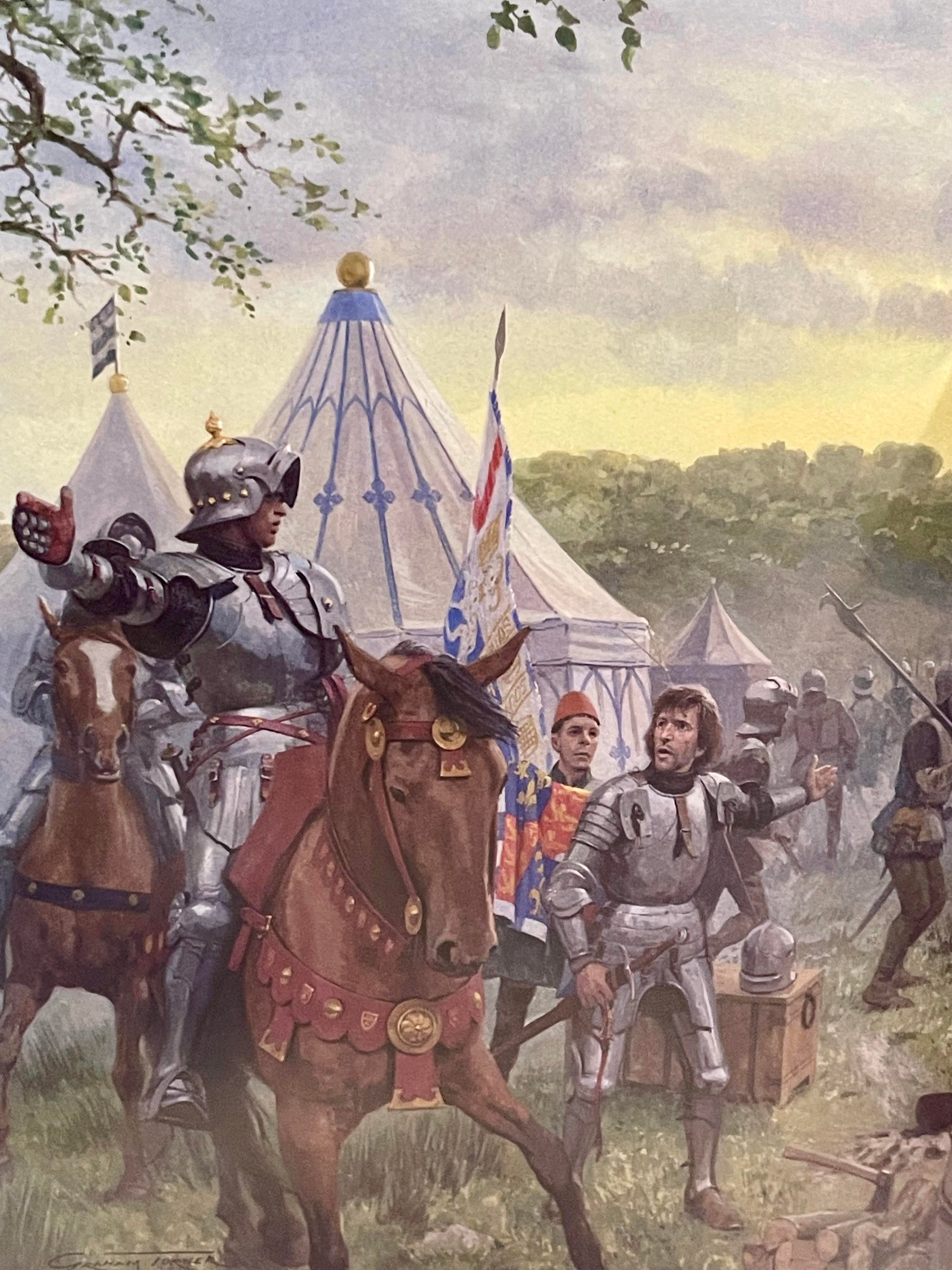
We lack a contemporary depiction of Henry Beaufort, duke of Somerset by Graham Turner has drawn and painted the duke hurriedly gathering his forces at Hexham.
Whilst the duke of Somerset had managed to escape in the aftermath of the battle of Hexham, he was soon captured along with the lords Roos and Hungerford. Although the king himself had shown Somerset mercy only a matter of months earlier, his cousin, the lord Montagu was a lot less willing to do so and ordered for the duke’s execution as well as Somerset’s two fellow Lancastrian nobles. On 15 May a scaffold was hastily built in preparation for the execution of a royal duke. A ragged Somerset was pushed forcefully towards to the site of his imminent execution, then clambered up the scaffold’s creaking wooden steps, greeting the wooden stump that anxiously awaited his neck before he placed his head upon the block and awaited the final blow. Roos and Hungerford received the same fate only a couple of days later.
The death of the duke of Somerset marked somewhat of a turning point in Edward IV’s reign. In the Yorkist king’s viewpoint his attempts of ingratiating former stalwart Lancastrian’s back into the fold had been betrayed, namely by the man who the king could have perhaps considered a friend. Following Yorkist successes at Hedgley Moor and Hexham a small Lancastrian purge was committed that saw the deaths of not only Somerset, Roos, Hungerford and Percy but also William Tailboys, de jure 7th baron Kyme along with another 30 individuals. A very similar event occurred when Edward IV recaptured his throne in 1471.
Henry Beaufort, 3rd duke of Somerset was not the first of his family to be executed on the orders of a Yorkist nor would he be the last, that honour would befall his younger brother, Edmund Beaufort, 4th duke of Somerset after the Lancastrian defeat at Tewkesbury saw Edmund’s execution carried out and with it the extermination of a house that had been at the forefront of English politics for roughly a century.
Sources/Further Reading
Nathen Amin, House of Beaufort: The Bastard Line that Captured the Crown (Shropshire: Amberley, 2017)
Cora L. Scofield Brewster, Henry, Duke of Somerset and Edward IV, The English Historical Review, Vol. 21, No. 82 (April 1906),pp.300 - 302
Gregory’s Chronicle in The Contemporary English Chronicles of the Wars of the Roses, ed.by, Dan Embree and Mary Teresa Tavormina (Suffolk: Boydell & Brewer, 2019)
Julian Humphrys, Enemies at the Gate: English Castles under Siege from the 12th Century to the Civil War (Historic England, 2007)
David Santiuste, Edward IV and the Wars of the Roses (Bradford: Pen and Sword, 2011)